Use Case
Glasses Don't Sell Without a Face
Eyewear is our most documented client category — premium frame brands on monthly retainer. Model shots are the conversion driver, fit accuracy is the craft, and we learned both the expensive way so you don't have to.

The Challenge.
Eyewear has the hardest conversion requirement in e-commerce: customers need to see frames on a face before they'll buy, because fit IS the product. Flat packshots don't answer 'will these suit me' — and traditional model shoots for every frame, in every colorway, every season, are exactly the recurring cost that crushes independent frame brands.
AI doesn't make it automatically easier — eyewear is technically brutal. Frames are thin, reflective, precisely proportioned objects sitting on the most scrutinized part of the human body. Naive generation gets the fit wrong in ways everyone instantly sees: frames too wide, lenses warped, glasses floating above the ears — or sitting above the eyebrows, which is exactly what happened on one of our own client projects when a comp card with sunglasses pushed up on the model's head contaminated every composite. Three hours lost to one dirty source image.
And premium eyewear can't survive on generic 'aesthetic' imagery. A $300 titanium frame needs a world — craft, materials, place — or it looks like a $30 frame with ambitions.
How Dezygn Solves This.
Eyewear is where Dezygn's workflow has the deepest real-world mileage: premium frame clients on monthly retainer, including a $700/month engagement that started as a single cold-outreach proof image. The model workflow exists because of this category: model briefs from the brand identity, comp cards for selection only, then clean portraits — white background, plain tee, zero accessories — for compositing, because the source image wins over the prompt. Always. With a clean portrait and a clean product image, the glasses sit correctly on the first try; that's the lesson those three lost hours bought. Accuracy runs deeper than fit. For a Japanese titanium brand, we researched the material itself and how the category's top competitors photograph titanium — angles, reflections, surface treatment — then traced the brand's craft origins to Sabae, Japan's eyewear capital, and built the scene world from that region. Ultra-close product shots used uniform diffused cool studio light so the matte titanium read true. For a Parisian brand, the same system produced the opposite energy: paparazzi flash, café exits, 'never poses for pictures' attitude. Same framework, two completely different brands — that's the point.
Fit-Accurate Model Shots
Clean-portrait compositing puts frames where frames sit: rim below the brows, natural temple gaps, width proportional to the face. The conversion shot, done right.
Material-True Frames
Titanium, acetate, tortoiseshell marbling, gold hinge details — reflective-material lighting and macro recipes that survive close inspection.
Micro-Iteration for Hard Shapes
Narrow profiles and unusual silhouettes that AI keeps 'correcting' get systematic micro-iterations — vary only the shape language until the render matches the frame.
Brand Worlds From Real Research
Scene libraries built from your brand's actual geography and craft story — the difference between 'Japanese aesthetic' and a world competitors can't copy.
Campaign Range on One System
Packshots, ultra close-ups, model editorial, paparazzi energy, atmosphere shots — a full 12-image campaign mix from one calibrated setup.
$700/mo
Real eyewear retainer, landed with one proof image
137→12
Generations → approved finals on a real premium campaign
1st try
Composite accuracy with clean portrait + clean product
Related Use Cases.
Jewelry
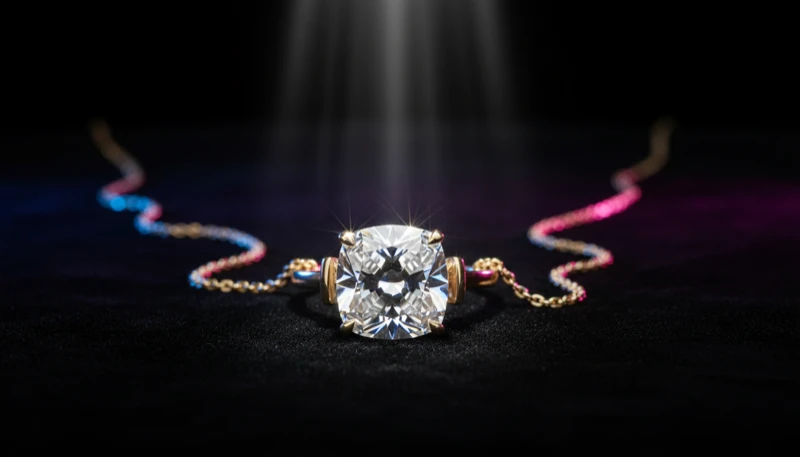
Jewelry is the category where photography most often over-promises — and where 'smaller than expected' returns eat margins. Accurate scale, honest metal, real sparkle: that's an engineering problem, and it's solvable.
Fashion & Accessories
Bags, eyewear, scarves, jewelry, outerwear — accessories are AI photography's sweet spot. Garment fit is the honest frontier. We work both, from real client campaigns.
Beauty & Cosmetics
No category consumes more creative or scrutinizes it harder. Consistent models, honest skin texture, true-to-tube shades — at the publishing cadence beauty demands.