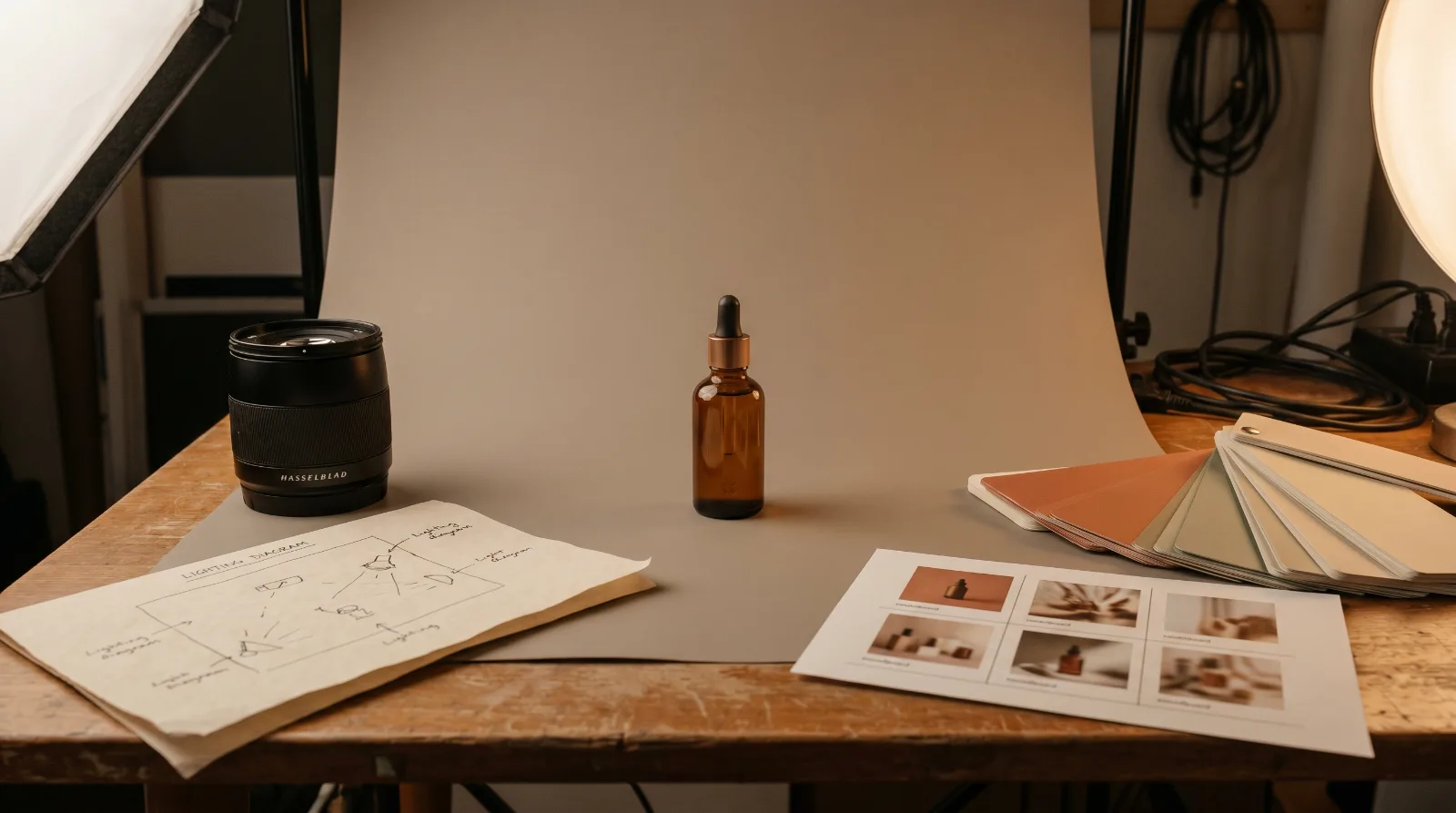
The Slot Machine Trap
Most people use AI image generation like a slot machine. They type something vague ('woman holding cream jar, professional, beautiful'), they spin, they hope. Maybe this time it will be good. That is not a profession. That is gambling. And the output has a name: AI slop. Inaccurate products, melting hands, plastic skin, images that damage trust instead of building it.
Here's the version of this that costs real money. A toy company owner generates his own catalog images with AI. The images look great, better than the product, in fact. A customer orders, the box arrives, and the review comes in: two stars, 'item not as pictured.' Not because the toy was bad. Because the image promised something the physical product didn't deliver. 'Close enough' isn't a style choice. Close enough is a refund. And refunds kill businesses.
Professional AI photography replaces luck with engineering. Every image has to pass three tests we call conversion integrity: it must be accurate (the image respects the physical product's reality), realistic (it passes the sniff test, people can smell AI from a mile away now, and when they smell it they close their wallet), and on-brand (it speaks the client's visual language). Clients aren't paying you to prompt. They're paying you to bridge the gap between raw AI potential and commercial reality.
The Six Ingredients
Every commercial image you've ever seen can be broken down into exactly six controllable ingredients. Control these, and you control the outcome. I didn't invent them from theory. After hundreds of client generations, every time the AI gave me slop instead of a usable image, it was because I had left one of these undefined.
STYLE: what kind of photo is this? Clean catalog, editorial luxury, lifestyle, UGC, moody, minimalist. Style is the container; everything else lives inside it. SUBJECT: what or who is the hero? The product with its real shape, materials, finish and label text, or the model who matches the client's actual customer. ACTION: what's happening? The verb, the expression, the gaze. Static images are forgettable; action creates desire.
SCENE: where are we, and how is it lit? Environment plus lighting, and lighting is 50% of the equation: get it wrong and nothing else matters. CAMERA: how are we shooting it? Focal length, aperture, framing. Three lenses cover 80% of commercial work: 50mm feels honest, 85mm feels premium, 135mm feels cinematic. BRAND: how does this feel like them? Exact hex colors (not 'navy blue' but '#1B3A57'), color temperature, identity textures. Brand stays constant across a campaign while everything else changes; that constancy is what reads as identity.
The framework only works if you use all six. Skip one, and you're back to gambling.
The Ordering Rule: Hierarchy of Attention
The AI pays more attention to the beginning of your prompt than the end. Think of AI attention like a budget. You have a limited amount to spend, so front-load the things that matter most and don't waste budget on the obvious.
The default order (Style, Subject, Action, Scene, Camera, Brand) works for most shots. You break it when something isn't coming through. Brand burgundy keeps rendering as generic red? Move the brand block to the top and repeat the critical detail across ingredients. Unusual product proportions getting normalized? Front-load them. The order is a tool, not a ritual.
Multimodal Anchoring: Words vs. Pictures
Here is the insight that separates amateurs from professionals: each ingredient can be communicated with words, with pictures, or both. Words describe. Images define.
Use text when you want the AI's interpretation: mood, era, vibe, creative variation. Use images when accuracy matters: the product's exact appearance, a specific pose, an exact style. The AI doesn't know what your product looks like. If you're vague, it will guess, and its guess won't match reality. Attach the real product photo and the AI recreates it instead of inventing it.
Two corollaries do a lot of work in practice. First, the over-description trap: don't write 400 words describing what your reference image already shows. 'Using [image1] as compositional template, recreate with the eyeglasses from [image2].' Fifteen words, and the images do the heavy lifting. Let the image speak; use text for what the image doesn't show. Second, visual signal-to-noise: the more focused your source image, the cleaner your transfer. Crop the source to what you want to keep. A busy source is noise the AI must reproduce or fight; a clean source is signal.
And one rule above all, learned the expensive way on client work: the source image wins over the prompt. Always. If your source shows sunglasses sitting above the eyebrows, no prompt will move them down. Fix the source, not the prompt.
From Framework to Production
Visual Syntax is how you think; the shot types are how you ship. A packshot fixes Style and Camera and spends everything on Subject accuracy. A hero shot spends on Camera and lighting drama. A UGC shot deliberately inverts the polish rules while keeping the product accurate. Once you see images as ingredient stacks, you can deconstruct any reference a client sends and rebuild it with their product, which is the actual job.
This framework is also what Dezygn's AI creative director, Awa, runs on. You define the brand block once, anchor products with real photos, build scenes as reusable assets, and Awa assembles shots instead of gambling on them. The full system (the R&D process, the per-shot recipes, the client workflows) is what we teach, but the framework above is enough to change how you prompt today.
Key Takeaways.
- Every commercial image breaks down into six controllable ingredients: Style, Subject, Action, Scene, Camera, Brand. Control these and you control the outcome.
- Accuracy is non-negotiable. An embellished image is an 'item not as pictured' refund waiting to happen.
- Lighting is 50% of the equation; three lenses (50/85/135mm) cover 80% of commercial work.
- Words describe, images define: anchor products with real photos, use text for mood and relationships.
- The source image wins over the prompt. Always. Fix sources, not prompts.
- The AI reads the start of your prompt hardest. Front-load what matters, repeat what isn't coming through.
Ready to Put This Into Practice?
Dezygn gives you the AI creative tools, training, and community to turn these insights into real results for your clients.
Start Free