What Shannon Descent is
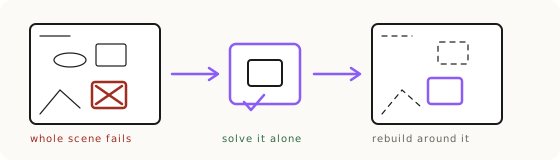
Shannon Descent is the diagnostic move you make when an AI product image keeps failing and you cannot tell what is breaking it, or when every fix inside the full scene fails anyway. You throw away everything except the smallest piece that still fails, perfect that piece alone, then rebuild the scene around the solved anchor, checking it survives each step. It is named for Claude Shannon's Creative Thinking method: reduce a big problem to its smallest part, and progress in tiny increments. Use it when you are debugging, not planning. If you already know a shot is complex and are laying out the build order in advance, that is a sequential pipeline. Shannon Descent is the same decomposition instinct applied after something already broke.
Named for Claude Shannon: research, not vibes
The name comes from Claude Shannon's talk on creative thinking, where he describes attacking a hard problem by shrinking it to its smallest version, solving that, and building back up in small increments. That talk is the one that reframed this whole craft for me as research, not vibes. Product accuracy is not a lucky spin; it is a method you can run on purpose, and Shannon Descent is the method for the moment you are lost. It is one of the core product-accuracy routes: when you don't know which variable is wrong, you don't keep guessing at the full scene, you descend to the part that fails and study it in isolation until you can see the truth of it.
Why isolating the piece works
A complex scene is a crowd of instructions competing for attention. The piece you actually care about, the flange, the lettering, the one tile, may be getting too small a share of the model's attention to ever come out right, because it is drowned out by everything else you asked for in the same prompt. Isolate that piece and the situation flips: with nothing else in the frame to serve, the model pours all of its attention into the one thing you left. That concentration is the entire point. You are not just simplifying the prompt, you are finally able to SEE whether the piece is right, because there is nothing else in the image hiding the failure or explaining it away.
The mahjong table: forget the rest
Here is what it looks like in practice. On a mahjong lifestyle scene, I had made several failed full-scene attempts, product plus table plus room plus lighting, and none of them held together. So I stopped and shrank the whole job down to one element. In my own words at the time: "ok I think I'm too ambitious, let's try something else. Using image one create a visual of these sets of tiles on a green table. That's it, forget the rest. Just the table for now."
Once the table was solid, it stopped being the problem and became the anchor. I rebuilt the scene back around it, one checked step at a time, and the parts that had been impossible to get right in one shot fell into place because the hardest piece was already solved and locked. "Forget the rest, just the table for now" is the whole technique in one line: refuse to solve the scene, solve the smallest failing piece, then let it carry the rest.
How far you can shrink
You can shrink surprisingly far. The piece does not have to be a whole object; it can be a single element, and it can go all the way down to a single instruction inside the prompt. If lettering is coming out wrong in every composite you generate, do not keep fighting it inside the full scene. Generate the lettering alone, on a plain white background, with its true material and finish, get it perfect there, and only then composite it back in. The failure had nowhere to hide once it was the only thing on the canvas.
This is why descent pairs so naturally with the culling loop and with fixing the input. Once a piece is isolated, you can run slight micro variations of just that piece and cull to the clean one, the same control vs variant discipline you would use anywhere else, except now the variable is small enough that the odds are finally on your side.
It works in reverse too: build the world, then place the product
Shannon Descent is not only for pulling a broken piece out of a scene. It runs in reverse just as well: build the empty container first, get it approved, then place the product into it. On a lighting brand's room, instead of trying to generate the apartment and the fixture together and hoping both came out right, I built the apartment first and added the lighting only once we were happy with the room. Scene first, hero product second, each step verified before the next.
The principle underneath both directions is the same one that runs through the whole product-accuracy method: never ask the generator to bridge a big delta in one step. Whether you are isolating a failing piece or building a scene up around a solved one, you are shrinking the jump until the model can clear it, and checking each landing before you carry it forward.
When to descend, when to re-roll, when to switch technique
Not every failed generation calls for a descent, and knowing which lever to pull is half the skill. If a one-shot fails, the first thing to try is simply generating a few more variations, because accuracy work is probabilistic and a high discard rate is the filter doing its job. What you must not do is keep re-rolling the exact same prompt out of hope: past about ten generations on one unchanged prompt, the prompt is the problem, not the dice.
So the decision goes like this. Re-roll when the prompt is basically right and you just need a clean roll. Switch technique when one route keeps failing, because forcing the same method harder rarely helps, and you should never technique-hop at random but you should change methods deliberately when a route is clearly stuck. Drop into Shannon Descent for the specific case in between: you cannot tell WHICH part is failing, or the full-scene context is defeating every fix you try. That is the moment to shrink the problem until it can't hide.
Rebuilding: check that the anchor survives each step
Solving the isolated piece is only half of it. The second half, the part people skip, is rebuilding the scene around the anchor without letting anything undo the fix you just earned. Add one thing back at a time and verify at every step that the solved piece is still right. If you fixed the table and then generate the full room in one jump, you have handed the model a big delta again and it may quietly re-render your anchor and drift it. Rebuild in the same small increments you used to descend.
This is the gate discipline running in reverse. On the way down you shrink until the failure is visible; on the way up you add back one variable and stop to check before you carry it forward, because a mistake reintroduced at any step poisons everything after it. That is the whole reason the descent works: you never again let the model touch the anchor and the rest of the scene in the same uncontrolled move. Small step, check, keep, repeat, until the scene that was impossible in one shot is standing around a piece that cannot fail.
Descent vs the sequential pipeline
Shannon Descent and the sequential pipeline are close relatives, and it is worth being clear on the difference so you reach for the right one. A sequential pipeline is the planned build order for a shot you already know is complex: you decide up front to build it in checked steps, ingredients, composite, scene, style, quality gate, because you can see the complexity coming. Shannon Descent is the diagnostic version of the same instinct, and you reach for it after something already broke, when the plan you had is not working and you need to find out why.
In both cases you are decomposing a hard problem into pieces small enough to solve and verify one at a time. The pipeline decomposes forward, from a plan. The descent decomposes downward, from a failure. Learn both and you stop staring at a scene that won't come right, and start shrinking it until the failing piece has nowhere left to hide.
Key Takeaways.
- Shannon Descent means shrinking the problem until it can't hide: isolate the smallest failing piece, perfect it alone, then rebuild the scene around the solved anchor.
- It is named for Claude Shannon's method of reducing a big problem to its smallest part and progressing in tiny increments.
- A complex scene is a crowd of instructions competing for attention; isolate the piece and the model pours all its attention into it, so you can finally see whether it is right.
- You can shrink far: down to a single element, or even a single instruction inside the prompt.
- It runs in reverse too: build the empty scene first, get it approved, then place the product into it.
- Re-roll a right-ish prompt, switch technique when a route keeps failing, and drop into Shannon Descent when you can't tell which part is broken.
Ready to Put This Into Practice?
Dezygn gives you the AI creative tools, training, and community to turn these insights into real results for your clients.
Start FreeRelated Resources.
How to Get Product Accuracy with Nano Banana
Product accuracy in AI product photography is a discipline: name the defect, diagnose it, route it to the right technique, judge the output. Measured, not luck.
Read guideThe Sequential Pipeline: Build Complex AI Product Shots in Checked Steps
Chain for control: decompose a complex AI product shot into validated intermediate assets with a hard quality gate between every step.
Read guideThe Product Accuracy Route Map: Diagnosis to Technique
How do you fix an inaccurate AI product image? Name the defect on one of 8 fidelity axes, then route to the exact technique that clears it. The full map.
Read guide