What the Sequential Pipeline is
The Sequential Pipeline is how you build an AI product image when the job needs control over its parts. Instead of asking one prompt to do everything at once (product, pose, scene, style, lighting), you build the image in small steps, and each step must produce a validated intermediate asset before the next one begins. You lock the model and the product first, confirm they are right, then place them in a scene, then style it, checking each landing along the way. That checked build order is especially useful when a hero packshot has to stay accurate while carrying a more ambitious scene and lighting treatment.
This is a peer technique to one-shot generation, not a lesser option and not a fallback. The two have different jobs. One-shot is the cheap first try when the delta is small and the reference is sharp: one prompt, three variations, cull. The Sequential Pipeline is the build order when the job needs control that a single prompt cannot hold: a consistent model built separately, an angle the product was never photographed from, several products composited into one scene, a complex object like eyewear or jewelry, or any shot where you need to gate the accuracy before you spend generations on the background. You chain for control, not by default. The rest of this page is how to run the pipeline and when to reach for it.
The Small Steps Law: shrink the delta until the model can clear it
Underneath the whole thing sits a single law. Never ask the generator to bridge a big delta in one step. A delta (a jump) is the distance between what your inputs already show and what you are asking for. If your reference is a front-facing product and you want it on a model at the beach in three-quarter view, that is three transformations, not one. Every technique in this library is one idea repeated: a way of shrinking the delta until the model can clear it.
The pipeline is the literal expression of that law. You cut one impossible jump into several small ones and check each landing. But the law does not say "always chain." It says never ask for a jump the model cannot make. When the jump is already small (a sharp reference and a simple placement), one shot clears it in a single move, and adding steps only introduces new places for the product to drift. The law is about the size of the delta and the control the job needs, not the number of prompts. Chain when the delta is genuinely too big for one move, or when you need to lock an ingredient (a consistent model, a created angle) before anything else can happen.
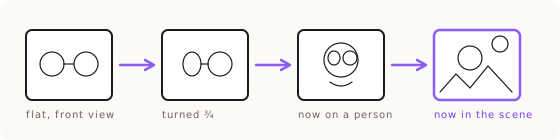
The build order: five steps is one example, not a law
Complex images aren't one problem. They're several sequential problems. The canonical build chain for a model-plus-product-plus-scene job is five steps: select your ingredients (clean portrait, clean packshot, scene, style refs), composite the model and the product, place that composite into the scene, apply style and action, then run the quality check. That is the shape most people learn first, and it is a good default for the hardest common case.
But five is not a fixed law. It is what a model-plus-product-plus-scene job happens to need. A simple placement might be two steps. A multi-product campaign might be seven. The number of steps comes from the job in front of you, not from a rule. What never changes is the invariant: decompose the work into validated intermediate assets, and put a hard quality gate between every step. Add a step whenever a jump is too big for one move; skip a step whenever the model can already clear the gap. The gates are the law. The count is just bookkeeping.
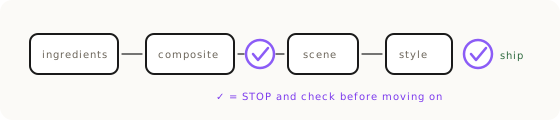
The composite step most people forget
The step most people skip is the composite: model plus product, on its own, before any scene exists. Clean portrait plus clean packshot, nothing else in frame. That is where you actually solve the hard problems, so validate accuracy there before you spend a single generation on the background. If the product is wrong on a plain white composite, it will be wrong in every scene you build on top of it, and you will have wasted the scene generations finding that out.
Skip the composite step for simple products (a t-shirt, a bottle) where the product barely changes. Do it religiously for eyewear, jewelry, transparent materials, and small branded details, where a millimetre of drift on a hinge or a logo is the difference between these sunglasses and some invented pair that only looks like them. The same decomposition applies to structural edits, not just model-and-product shots: recreate the core element, collage it in, then outpaint the scene around it. The instinct is always the same. Lock the thing that has to be exact, prove it is exact, then build outward.
The gate discipline: fix it here
A pipeline is only as good as its gates. The discipline is a hard stop at every stage: is the product right? The fit right? The face right? Fix it HERE. A mistake carried forward poisons everything after it. If the label text is wrong at the composite stage and you push on to lighting and scene, you are now polishing a defective product, and every downstream generation inherits the flaw. The gate is where you catch it while it is still cheap to fix.
It mirrors real photography. No photographer sets up model, product, lights and set at once for one exposure. They light the subject, check it, add the set, check it again. The gates are not bureaucracy. They are the reason one-shotting a complex image once ate eight hours while the pipelined version ships in a fraction of that. Ship the finished image only through a final quality gate: score all six ingredients one to five, and ship only at four or above on every one.
Separate the stages into different sessions
Run the stages in different sessions: models in one session, scenes in another, composites in a third. Context bleeds between stages and pollutes them. If you build a model, then a scene, then a composite all in the same conversation, the model starts dragging details from the scene into the product and from the product into the face. Keeping the stages apart keeps each generation clean, because each session only holds the ingredients that stage actually needs.
This is the same reason the composite is done on a plain background with nothing else in frame. Every extra thing in the context is another instruction competing for the model's attention, and the piece you care about gets a smaller share of it. Strip the context down to exactly the job of that step.
When not to pipeline: try one-shot first
The pipeline is for control. When you do not need that control, do not reach for it. If your reference is sharp, the product is simple, and the ask is a small placement, one-shot from that reference, generate three variations, and cull. One-shot is always worth a try: it is cheap to test, and when the delta is small it is not the lazy option, it is the accurate one. Adding pipeline steps to a small delta only spends extra generations accumulating drift.
We measured this internally, and with a sharp reference on a single-product single-placement job, the one-jump route beat the chained routes cleanly. That result describes one narrow scenario, not a global ranking, and it does not make the pipeline a fallback. It makes the choice concrete: match the technique to the job. Reach for the pipeline when you need control (a consistent model, a created angle, a multi-product composite, a complex product, gated validation) or when a one-shot has failed and re-rolling the same prompt is not getting there. Do not chain a small delta out of habit, and do not one-shot a big one out of hope.
The scar: five hours on one eyewear drop
This pipeline is scar tissue. On a February eyewear drop I tried to merge scenes, models and glasses in one shot and burned about five hours before admitting the obvious: "I was trying to do too many things at once. For complex objects like glasses, you need to simplify to the max. You also need to avoid introducing visual pollution early."
The fix became the pipeline. Strip the comp cards down to a white tee on a white background, lock the model and the glasses together first, prove that composite is right, then and only then place it into a scene. The hard problem (a specific pair of glasses sitting correctly on a specific face) got solved once, in isolation, at the composite gate, instead of being re-fought inside every scene attempt. That is the whole move: find the step that is actually hard, do it alone, gate it, and never carry a defect forward.
Shannon Descent: the diagnostic sibling
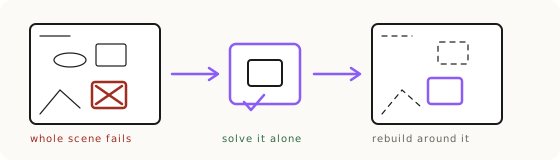
The Sequential Pipeline is the planned build order for a shot you already know is complex. Its sibling, Shannon Descent, is the same decomposition instinct applied after something already broke. Sometimes a chain fails and you cannot tell which step did it, or every fix inside the full scene fails anyway. That is when you switch from building to diagnosing. Shannon Descent means shrinking the problem until it can't hide: throw away everything except the smallest piece that still fails, perfect it alone, then rebuild the scene around the solved anchor, checking it survives each step. It is named for Claude Shannon's method of reducing a big problem to its smallest part and progressing in tiny increments.
It works because a complex scene is a crowd of instructions competing for attention, and the piece you care about may get too small a share. Isolated, the model pours all its attention into it, and you can finally see whether it is right. On a mahjong lifestyle scene, after several failed full-scene attempts, I stopped: "ok I think I'm too ambitious, let's try something else. Using image one create a visual of these sets of tiles on a green table. That's it, forget the rest. Just the table for now." Once the table was solid it became the anchor, and the scene got rebuilt around it. You can shrink surprisingly far, down to a single element or even a single instruction inside the prompt. Plan the pipeline when you can see the complexity coming; drop into Shannon Descent when the plan you had stops working.
Key Takeaways.
- The Sequential Pipeline is a peer technique to one-shot, not a fallback: one-shot for a small delta with a sharp reference, the pipeline for when the job needs control.
- The invariant is decompose the job into validated intermediate assets with a hard quality gate between every step. The five-step build is one example, not a law: the number of steps comes from the job.
- The composite step (model plus product, on a plain background) is the one most people skip, and it is where you actually solve the hard problem. Validate accuracy there first.
- Gate every step: fix a mistake at its stage, because a mistake carried forward poisons everything after it.
- Separate the stages into different sessions so context does not bleed between them.
- Try one-shot first when the delta is small; reach for the pipeline when you need control or when a one-shot has failed. When a chain breaks and you can't see why, drop into Shannon Descent.
Ready to Put This Into Practice?
Dezygn gives you the AI creative tools, training, and community to turn these insights into real results for your clients.
Start FreeRelated Resources.
The Product Accuracy Route Map: Diagnosis to Technique
How do you fix an inaccurate AI product image? Name the defect on one of 8 fidelity axes, then route to the exact technique that clears it. The full map.
Read guideHow to Get Product Accuracy with Nano Banana
Product accuracy in AI product photography is a discipline: name the defect, diagnose it, route it to the right technique, judge the output. Measured, not luck.
Read guidePose-Match: Directing AI Models Without Losing the Product
What pose-match is and when to use it: the route for creating a product reference that doesn't exist yet, plus the eval that says use one jump, not a chain.
Read guide