What micro-iteration is
Micro-iteration is what you do when a single detail won't render and you've narrowed the failure down to one word. You don't retry the same prompt. You vary only the language around the problem area, keeping everything else in the prompt frozen, and you run 10 to 15 of those variations. Two or three of them will land. The framing that makes it click: generation is a dice roll, so roll many dice, all of them aimed at the same one word. It is the lightweight, in-session version of the control vs variant method, for the specific case where you already know which word is the problem. Retrying the same prompt and hoping is the slot machine. Micro-iterating is directed search.
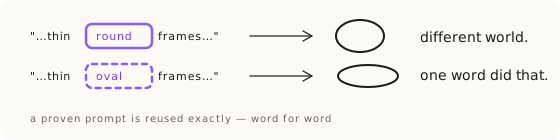
Why generation is a dice roll
On hard projects, one word out of a thousand can change the whole output. That is not a metaphor, it is the mechanism you're exploiting. An image model is sampling: the same prompt run twice produces two different images, because there is randomness baked into every generation. Most of the prompt is doing its job and holding steady, but one contested word (a shape, a proportion, a material) sits on a knife edge, and each roll of the dice lands it a little differently. Sometimes the detail holds, most times it doesn't. That is exactly why hammering the same prompt over and over feels like a slot machine: you are pulling the lever on the same odds and praying the randomness breaks your way. Micro-iteration accepts the randomness instead of fighting it. You keep rolling, but you change the one word each time so you're not just re-rolling identical odds, you're searching for the phrasing the model renders correctly.
The descriptor ladder
The core tactic is a descriptor ladder: take the one failing word and write out a rung of near-synonyms and qualified variants, then generate against each one with the rest of the prompt untouched. The canonical example is a pair of narrow glasses from an eyewear drop that kept rendering too tall. Instead of rewriting the prompt, I varied only the shape descriptor: "oval" became "elongated oval," then "narrow oval," "flattened oval," "slim oval." I also added a hard constraint next to it, "CRITICAL: only 4cm vertical height." Everything else stayed frozen.
The ladder works because the model does not weight all of those words the same, even though a human reads them as roughly synonymous. "Elongated" pulls the shape one way, "flattened" pulls it another, and one of those rungs happens to sit closer to the geometry you actually want. You cannot predict which rung wins in advance, so you don't try. You write four or five plausible rungs and let the generations tell you. The full walkthrough of this drop lives in control vs variant; here the point is the mechanic underneath it, which is that a ladder converts one stuck word into a small search space you can actually cover.
The 10-to-15 burst
Once you have the ladder, you fire a burst: 10 to 15 generations spread across the rungs, all with the same frozen base prompt. You are not looking for the prompt to become reliable. You are looking for the two or three outputs, out of the fifteen, where the contested detail happens to hold. Those are the keepers. The rest go on the discard pile, and that is normal, not failure. Even a correct prompt produces keepers and misses because of the dice roll, so a burst that returns three usable frames out of fifteen has done its job. Then you stop. You do not keep bursting the same ladder hoping for a fourth. You take your two or three, and if the detail held cleanly, the failing word is solved and you move on to the next one.
When micro-iteration beats rewriting
The instinct when an image is 90% there is to rewrite the whole prompt to chase the last detail. That is almost always the wrong move, and micro-iteration is the corrective. A full rewrite changes ten things at once: you pile on more words, the model runs out of attention budget for the parts that were already working, and the layout or camera drifts even though you only wanted to fix a shape. You fix one thing and break three, and because you changed everything, you can't tell which edit caused which regression. Micro-iteration is the opposite bet. Freeze the whole prompt, touch exactly one word, and every generation in the burst is measured against the same stable background. When your image is close and only one named detail is wrong, micro-iterate. Save the rewrite for when the whole direction is broken, not for a single stubborn descriptor.
Its place inside control vs variant
Micro-iteration is not a rival to the control vs variant pipeline, it is the sub-move that lives inside it. Control vs variant is the full experimental method: lock an immutable control base, append isolated single-change variants, score each against the control, fold the winners into a new champion. That machinery is for when you know, or suspect, which thing is wrong and you're testing candidate fixes. Micro-iteration is what you switch to once that search has narrowed all the way down to one word. At that point you don't need a whole variant framework with a scored matrix. You need a ladder of phrasings for a single token and a burst of generations to test them. Think of it as the tightest inner loop of the same discipline: control vs variant is the formal experiment with a locked baseline and evaluated variants; micro-iteration is the same idea run lightweight, in-session, on one word. This tactic also pairs directly with the dimension and descriptor work in product accuracy with Nano Banana.
Where the technique sits in the rigor ladder
Micro-iteration is one rung on a ladder of escalating rigor, and knowing the rungs tells you when to reach for it. At the bottom is the slot machine: typing a vague prompt and pulling the lever, which produces AI slop and wastes hours. The first escape is structure, giving each generation a proper skeleton so the model isn't guessing at the basics. Micro-iteration is the next rung up: targeted variation on a single failing word once the structure is right and only one detail is off. Above it is the full control vs variant experiment, for when several things are contested and you need a scored matrix to sort them. You climb the ladder as the problem gets more specific, not more vague. Reach for micro-iteration precisely when the image is close and the failure has collapsed to one word, because that is the exact problem it is built for, and reaching for it too early (before you've named the one word) just puts you back on the slot machine with extra steps.
Planning the hit rate
Because micro-iteration is a dice roll you've aimed, you can budget for it instead of being surprised by the discard pile. Plan on roughly 10 generations per usable Model and Product shot for a hard product (glasses, jewelry, watches, transparent materials, small branded details), and about 5 for an easy one. That ratio is why the discard pile is the price of accuracy, not evidence you did something wrong. On the eyewear drop where the narrow-glasses ladder came from, the real counts were 137 generated, 27 shortlisted, 12 delivered. A 90% discard rate there was the visual filter working exactly as intended. So when you sit down to solve a stubborn detail, don't expect one clean fix. Expect to roll a dozen dice at the failing word and keep the two or three that come up right, and price the shot accordingly.
When the word won't hold no matter what
Micro-iteration has an edge, and knowing it is part of the skill. If you've narrowed to one failing word, built a full descriptor ladder, and 15 micro-variants still won't hold the detail, stop rolling. That word is no longer telling you the prompt is wrong. It is telling you the input is the bottleneck. Some things a ladder of phrasings genuinely cannot reach: a rotation the reference image never showed, a size the model has no way to anchor, a product that has to be re-posed or re-prepared before the generator can place it. Those are routing decisions, not iteration decisions. When the burst plateaus completely, the honest read is that you're at the top of the wrong ladder, and the fix is upstream, in the source image or the technique choice, not in a sixteenth synonym for "oval." Iterate inside a route; switch routes when iteration stops paying. The product accuracy route map is where you go to pick the next one.
Key Takeaways.
- Micro-iteration is for when you've narrowed the failure to one word: freeze the whole prompt, vary only that word, run 10 to 15, keep the 2 to 3 that land.
- Generation is a dice roll, so roll many dice all aimed at the same one word instead of re-rolling identical odds.
- Build a descriptor ladder ("elongated oval," "narrow oval," "slim oval") because the model weights near-synonyms differently and one rung sits closest to the geometry you want.
- Micro-iterate when one named detail is wrong; save the full rewrite for when the whole direction is broken, since a rewrite changes ten things at once.
- It's the lightweight in-session sub-move of control vs variant, run on a single word rather than a scored variant matrix.
- Budget roughly 10 generations per usable hard shot; if 15 micro-variants still won't hold the word, the input, not the prompt, is the bottleneck.
Ready to Put This Into Practice?
Dezygn gives you the AI creative tools, training, and community to turn these insights into real results for your clients.
Start FreeRelated Resources.
How to Get Product Accuracy with Nano Banana
Product accuracy in AI product photography is a discipline: name the defect, diagnose it, route it to the right technique, judge the output. Measured, not luck.
Read guideControl vs Variant: The Scientific Method for AI Product Images
How to fix an almost-working AI image without breaking it: lock a control, test one change per variant, and keep only the winners. Prompt-as-version-control.
Read guideThe Prior Test: When the AI Knows Your Product's Material Better Than You
How do you get AI to render a material correctly? Run the prior test: find out what the model already believes it looks like, then decide if words can fix it.
Read guide