
Shot Type
Styled Chaos Is Still Engineering
A flat lay is shot from directly overhead: products and props arranged on a surface, composed like a small still life. It reads as effortless, which is exactly why it's hard — every object in frame is a deliberate choice, and one off-brand prop breaks the spell. Flat lays shine when the story is 'what's in the set': bundles, routines, kits, ingredients, everything-you-get shots.
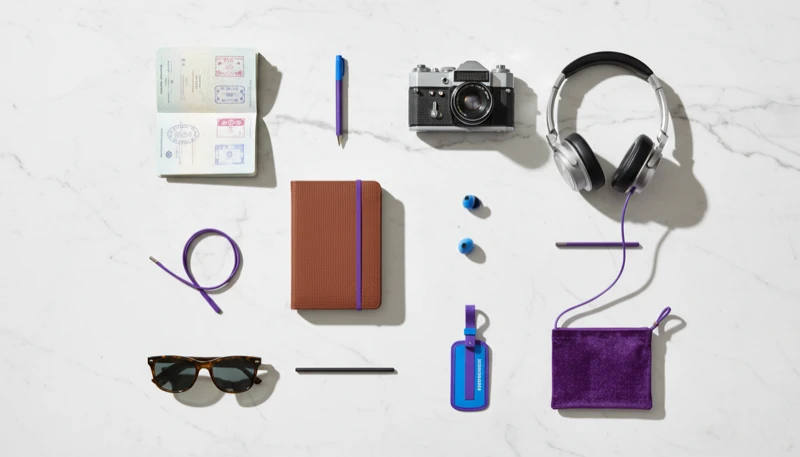
When to Use This Shot Type.
Bundles and kits, where one image has to show every item a customer receives
Social grids — flat lays are a native Instagram and Pinterest format and sit well next to lifestyle shots
Routine and ritual storytelling: the skincare shelf, the morning setup, the travel kit
Collection launches where products need to appear together with consistent styling
How Dezygn Creates These.
The flat lay recipe fixes Camera and frees Scene. Camera: overhead, f/8-style sharpness — every item in focus, because a flat lay with a blurry corner just looks like a mistake. Style: compositional, artistic, soft natural light.
The real engineering is in the prop system, and this is where brand identity earns its keep. Every brand vibe has a coherent material world: luxury wants marble, brass, silk and fresh peonies; natural-organic wants raw wood, linen, botanicals and stone; bold-playful wants saturated paper backdrops and graphic shapes. In Dezygn you define that world once — surface, palette, prop families, light — and Awa styles every flat lay inside it. The props change per shot; the world doesn't. That's how ten flat lays across a season still read as one brand.
Products go in as real source images, not descriptions, so labels and proportions survive. Props can be generated; the product can't be guessed.
Pro Tips.
01
Pick a hero, even overhead
A flat lay without a focal point is clutter. Give the primary product the visual weight — center-adjacent placement, the most contrast, the cleanest negative space around it — and let props orbit it. The eye should land on the thing for sale within a second.
02
Props must pass the brand filter
Before any prop goes in frame, it answers to the brand identity: would this object exist in the brand's world? Eucalyptus and travertine belong to a wellness brand; a neon stapler doesn't. The fastest way to make a flat lay look cheap is one prop from the wrong universe.
03
Odd numbers, deliberate gaps
Three or five supporting objects compose better than four or six, and negative space is a styling element, not wasted room. If the layout feels crowded, remove a prop before you shrink anything.
04
Keep the surface consistent across a series
If the campaign's flat lays jump from marble to walnut to concrete, the set falls apart on a grid. Lock the surface and light as part of the brand definition and vary the arrangement instead.
Create Flat Lay Photography with AI.
Generate professional flat lay photography in minutes, not hours. Dezygn's AI understands composition, lighting, and brand consistency.
Start FreeRelated Shot Types.
Packshot Photography
The packshot is your product, isolated on a clean background, lit evenly, with nothing else in frame. It's the shot Amazon requires, every marketplace expects, and every product page is built on. It is also where AI photography most often falls apart — because the packshot is a pure accuracy test. There is no scene to hide behind. If the cap is the wrong material, if the label text is mangled, if the proportions are off, the customer sees it instantly. Accuracy is non-negotiable here: an embellished packshot doesn't just look bad, it generates 'item not as pictured' refunds.
Learn morePackaging Photography
Packaging shots make the box, jar, pouch or tube the subject — the printed object a customer receives. For premium brands the packaging IS part of the product, and unboxing is part of the purchase. This is the hardest accuracy test in AI photography because it's full of text, and text is where generation fails loudest: one mangled letter on a label and the image is unusable. The brands that get this right treat label fidelity as an engineering problem with known rules, not a lottery.
Learn moreDetail Close-Up Photography
The detail close-up fills the frame with one square inch of the product: the hinge, the stitching, the milling, the weave. Its job is proof. Anyone can claim 'premium materials' in copy; the macro shot is where the claim gets checked. For premium products this is the conversion shot — customers paying $300 for titanium frames or $200 for a leather bag want to inspect the thing they can't touch. It's also the shot that punishes lazy sourcing hardest, because at macro distance every hallucinated detail is visible.
Learn more