
Shot Type
If the Pendant Is 2cm, It Must Look 2cm
A scale shot communicates true size by placing the product against a universal reference — a hand, a face, a table, a doorway. It exists because photographs lie about size by default: a 30ml jar and a 100ml jar look identical on white. 'Smaller than expected' is one of the most common reasons for returns and 1-star reviews, and it's entirely preventable. This is the most literal expression of the accuracy principle: if the pendant is 2cm, it must look 2cm. If the texture is matte, it cannot be glossy. The image is a promise the physical product has to keep.
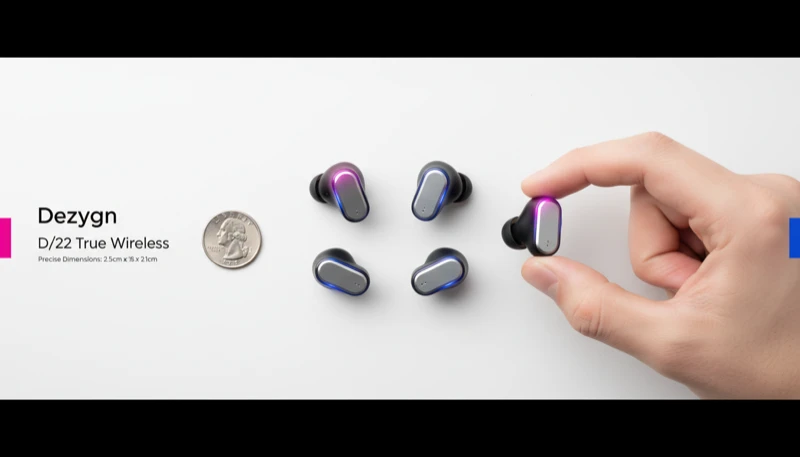
When to Use This Shot Type.
Jewelry, accessories and any product whose photos zoom past its real size — the categories where size disappointment drives returns
PDP image sets: at least one image in every listing should answer 'how big is it?' without the customer reading specs
Furniture and home goods, where room context is the size reference
Ads for products whose size IS the selling point — oversized blankets, compact gadgets, travel-sized kits
How Dezygn Creates These.
Scale accuracy starts before generation: document the product's real dimensions during product prep, because the AI doesn't know what your product looks like — and it certainly doesn't know how big it is. Vague inputs get guessed proportions; the guess won't match reality.
The engineering has two parts. First, the anchor: hands are the universal reference (everyone subconsciously knows hand size), faces work for eyewear and earrings, furniture and rooms work for decor. Second, honest camera language: 50mm, the focal length closest to human perception — it feels honest because it is. Avoid extreme close-up framing for the size-reference image; macro is for craftsmanship, not scale.
In the composite, the real product photo anchors proportions while the model or scene provides the reference. State dimensions explicitly in the subject block ('a 50ml frosted glass bottle,' 'a 16-inch chain') — specificity in, accuracy out.
Pro Tips.
01
Hands are the universal ruler
A product held, cradled or pinched between fingers communicates size faster than any dimension diagram. Match the hand to the customer (the model brief still applies) and keep the grip natural — how a person actually holds a serum bottle, not how a robot presents one.
02
Put dimensions in the prompt, not just the spec sheet
Write '30ml amber glass dropper bottle' rather than 'small bottle.' Capacity, length and counts are subject-block information, and they're the difference between a render that respects proportions and one that improvises them.
03
One honest size image per listing
Let the hero shot seduce and the packshot document — but make sure one image in every set exists purely to set size expectations. It's the cheapest returns-reduction tool in e-commerce.
04
Don't let flattering angles inflate the product
Low angles and tight crops make products look grander — great for hero shots, dangerous for scale truth. Keep the scale shot at eye level with natural perspective. Save the drama for frames whose job is drama.
Create Scale Shot Photography with AI.
Generate professional scale shot photography in minutes, not hours. Dezygn's AI understands composition, lighting, and brand consistency.
Start FreeRelated Shot Types.
Packshot Photography
The packshot is your product, isolated on a clean background, lit evenly, with nothing else in frame. It's the shot Amazon requires, every marketplace expects, and every product page is built on. It is also where AI photography most often falls apart — because the packshot is a pure accuracy test. There is no scene to hide behind. If the cap is the wrong material, if the label text is mangled, if the proportions are off, the customer sees it instantly. Accuracy is non-negotiable here: an embellished packshot doesn't just look bad, it generates 'item not as pictured' refunds.
Learn moreModel Shot Photography
Model shots put the product on a person — worn, held, used. For entire categories they aren't optional: eyewear, jewelry and apparel barely sell without a face or a body in frame, because fit is the purchase question. The professional standard is the dedicated model: one consistent, brand-matched face that appears across the whole campaign, so your store doesn't look like it hired a different person for every photo. The amateur standard is whatever face the slot machine spits out today.
Learn moreDetail Close-Up Photography
The detail close-up fills the frame with one square inch of the product: the hinge, the stitching, the milling, the weave. Its job is proof. Anyone can claim 'premium materials' in copy; the macro shot is where the claim gets checked. For premium products this is the conversion shot — customers paying $300 for titanium frames or $200 for a leather bag want to inspect the thing they can't touch. It's also the shot that punishes lazy sourcing hardest, because at macro distance every hallucinated detail is visible.
Learn more