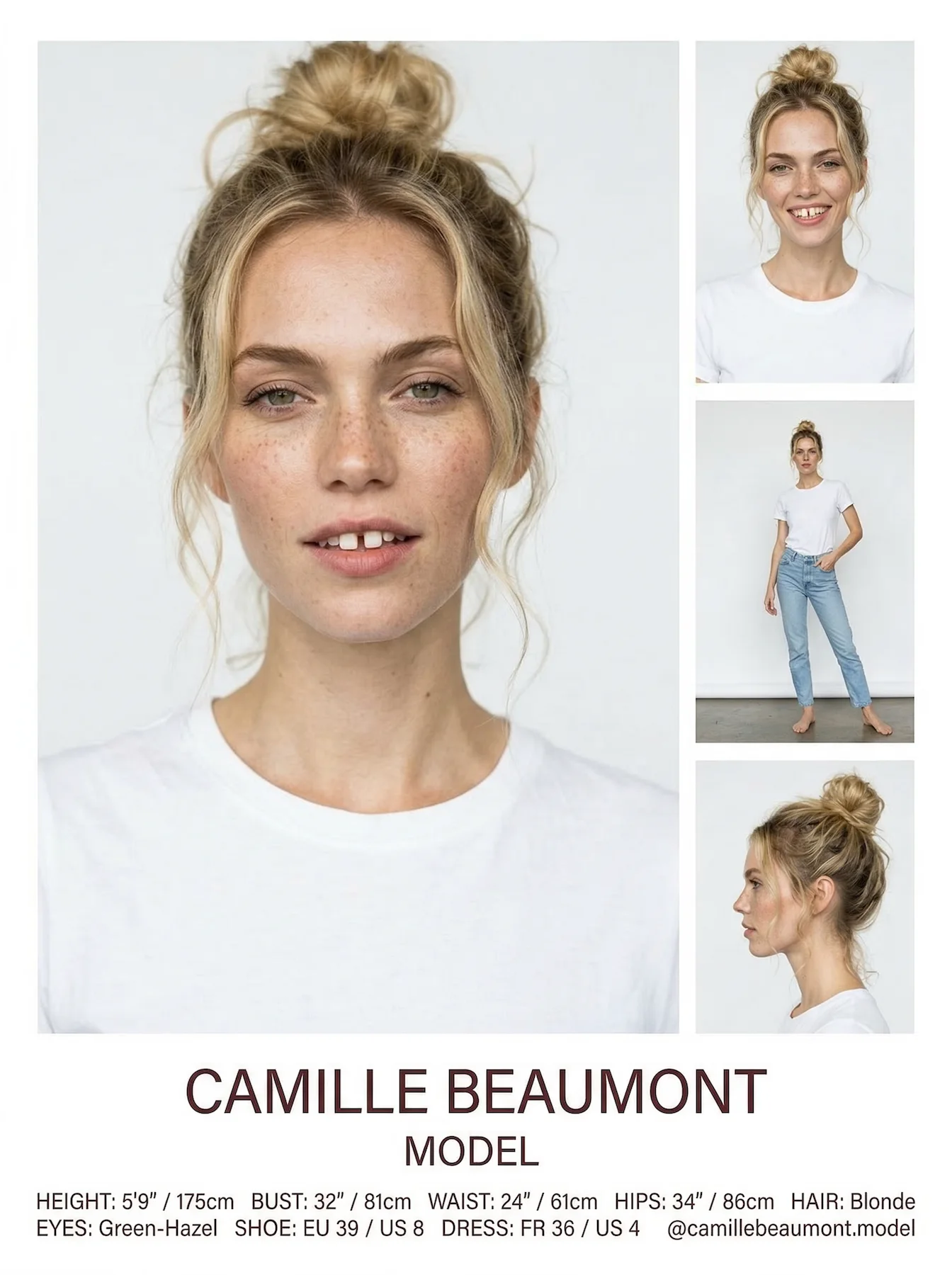
What a Comp Card Is
A comp card is a source-preparation technique: you create reusable synthetic models for character consistency across shots and drops. You generate each candidate model on a white or grey background, in a plain white tee, with no accessories, from multiple angles, then name it, tag it, and save it as an ingredient. Borrowed from the modeling industry (where agencies present talent on a grid of poses and angles), the comp card in AI photography does one job: it lets you or a client choose the right face before any campaign work begins. Use it whenever a brand needs the same recognizable person to carry a catalog, a campaign, or a content calendar rather than a different randomly generated stranger on every product. The selected face can then stay consistent from catalog frames through the campaign's statement image.
There are two assets per model, and confusing them is the expensive mistake. Every AI model gets a comp card (a grid of poses, only for CHOOSING the model) and a clean portrait (the only version you ever composite from). Said plainly: the clean portrait is your prepped ingredient, the comp card is the grocery bag. The grocery bag gets you the ingredient home; you do not cook with the bag.
The Clean Portrait Rule
The most important rule in the whole workflow: always generate a clean portrait variant, and composite ONLY from it, never from a styled comp card. The reason is a single mechanic that governs everything downstream: the source image wins over the prompt. Any clothing, background, or accessory sitting in your source image pollutes the composite, no matter what your text says. This is the polluted source rule, and it is why a comp card (which is deliberately full of competing poses and props for selection) is the worst possible thing to composite from. The clean portrait fixes this by giving the model nothing to leak: white background, neutral clothing, no accessories, one head-and-shoulders face.
The same discipline applies to products, not just people. Keep a clean isolated master alongside your styled shots, and build every composite from the clean master. Whether the ingredient is a face or a jar, a busy source is noise the AI has to reproduce or fight, and a clean source is signal. This is the Visual Syntax principle of visual signal-to-noise applied to your model library: the more focused the source, the cleaner the transfer.
Why the Source Wins: The Sunglasses That Would Not Move
I learned this the hard way on a retro eyewear client project. The original comp cards showed the models fully dressed against busy backgrounds. Compositing from those cost five wasted hours: the AI kept dragging the clothing and the scenery into every shot. Stripping the cards down to plain white-tee portraits fixed it. The sharpest lesson came from one comp card that had a pair of sunglasses tucked into a corner panel. That single prop cost three hours, because the composited glasses kept landing exactly where the panel's sunglasses sat, pushed up above the model's eyebrows, no matter how the prompt described them.
This is the whole argument for the clean portrait in one story. You cannot prompt your way out of a polluted source. If the source shows sunglasses above the brows, no wording moves them down. You fix the source, not the prompt. Once the cards were rebuilt clean, the technique became reliable: on a later project the Comp Card prompt generated all three models cleanly on the first attempt, a genuine one-shot success. The discipline is what turns a five-hour fight into a single clean generation.
How to Build a Comp Card
The build spec is deliberately boring, and that is the point. Generate the model on a white or grey background, in a plain white tee, with no accessories, showing multiple angles so you can judge whether the face holds across the grid. Then name it, tag it, and save it as an ingredient in your library so it can be reused across every future drop. The comp card handles casting; you evaluate consistency and range across the grid (does the face hold across angles, does the energy match the brand?) rather than gambling on a single render.
Then, and this is the step people skip, generate the matching clean portrait: one neutral head-and-shoulders shot, white background, neutral clothing, nothing else in frame. That clean portrait becomes the prepped ingredient every future composite is built from. Your model workflow runs brief to comp cards to clean portraits to composite: the brief is written from the brand identity, the comp cards handle selection, and the clean portraits become the source the rest of the campaign is assembled on.
Making the Model Read as Human
A comp card is only as good as the face on it, and generic prompts produce generic, plastic faces. Stack three to four facial features rather than naming one: Face = Shape + Chin + Cheekbones + Eyes + Lips (for example, oblong face, pointed chin, high cheekbones, hooded eyes, thin lips), and give the nose its own construction. Always specify ethnicity and an exact age, because vague prompts let the model fall back on stereotypes and drift.
Age and skin are where AI models betray themselves. For young ages, add the keyword 'youthful', otherwise a 20-year-old renders as 28 or older. For male models, negate the default stubble explicitly with 'clean-shaven', because the model adds facial hair on its own. Control emotion by volume, never with raw emotion words: 'quiet joy' and 'subtle smile', not 'happy'. And fight the plastic look directly with anti-plastic cues: 'natural skin texture with visible pores', 'slight facial asymmetry', 'authentic, unretouched appearance'. These cues are what keep a synthetic model on the human side of the sniff test.
Why Consistency Is the Commercial Point
The reason to comp-card a model at all is the dedicated model: one consistent, brand-matched face used across an entire campaign, catalog, or content calendar. Model inconsistency is one of the fastest amateur tells in AI imagery. A storefront where every product is worn by a different randomly generated person reads as exactly what it is. A dedicated model gives a brand the recognition asset that beauty and fashion houses pay heavily to maintain: the same face on the product page, in the ads, and across social. The comp card is how you cast that face once and the clean portrait is how you keep it identical across months of shots.
Casting is deliberate, not decorative. The model brief is written from the brand identity and specifies the customer's actual demographics and the brand's energy. 'Age 35 to 60, elegant, understated, calm presence, never demonstrative' for a minimal luxury brand reads completely differently from the 'never poses for pictures, owns the world' direction of an attitude-led campaign. The subject IS the customer avatar. Comp cards are just the mechanism that lets one deliberately cast avatar carry the whole catalog.
The Client-Facing Loop
Clients react to models the way a director reacts to casting, so build the loop around that. Generate a variety of candidates, shortlist them with the client, and only comp-card the winners. On one eyewear project the client rejected the initial models and changed the age brief from 35-to-60 down to 30. On another eyewear project the client wanted choice specifically on the female models. Neither of these is a failure of the technique; they are the technique working, because the comp card exists precisely to make casting a cheap, reversible decision before any campaign shots are committed.
This is why the two-asset split pays off commercially and not just technically. You spend generation budget producing a spread of comp cards for selection, the client picks a face, and only then do you invest in the clean portrait and the downstream shots. Choosing the wrong model costs you a few comp-card generations instead of an entire reshot campaign.
How Comp Cards Interact With Pose Work
It is worth being precise about what the pose grid on a comp card is for: choosing the model, and nothing else. The grid of poses helps you judge whether a face holds across angles and expressions during casting. It is not a pose reference you composite from, because composing from any panel of the card re-triggers the polluted source rule and drags that panel's clothing, props, and framing into your shot. When you actually need a specific pose in a finished image, you drive it from a clean portrait plus a dedicated pose reference, which is the job of pose matching, not the comp card.
Keep the roles separate and the pipeline stays clean: comp card for selection, clean portrait as the identity anchor, pose reference for the body position, real product photo for accuracy. This is the same route-planning discipline the product accuracy route map applies to products, and it sits inside the broader product accuracy playbook: decide what each source is allowed to contribute, and never let one asset leak a job that belongs to another.
Key Takeaways.
- Every AI model gets two assets: a comp card (a pose grid, only for choosing the model) and a clean portrait (the only version you ever composite from).
- The source image wins over the prompt, so any clothing, background, or accessory in your source leaks into the composite. Composite only from a clean, neutral portrait.
- Build comp cards on a white or grey background, plain white tee, no accessories, multiple angles, then name, tag, and save them as reusable ingredients.
- Consistency is the commercial point: a dedicated, comp-carded model gives a brand one recognizable face across the catalog, ads, and social.
- Make models read human by stacking 3-4 facial features, adding 'youthful' for young ages, negating default stubble, and using anti-plastic skin cues.
- Cast like a director: generate a variety, shortlist with the client, and comp-card only the winners, so the wrong model costs a few generations instead of a reshoot.
Ready to Put This Into Practice?
Dezygn gives you the AI creative tools, training, and community to turn these insights into real results for your clients.
Start FreeRelated Resources.
How to Get Product Accuracy with Nano Banana
Product accuracy in AI product photography is a discipline: name the defect, diagnose it, route it to the right technique, judge the output. Measured, not luck.
Read guidePose-Match: Directing AI Models Without Losing the Product
What pose-match is and when to use it: the route for creating a product reference that doesn't exist yet, plus the eval that says use one jump, not a chain.
Read guideThe Product Accuracy Route Map: Diagnosis to Technique
How do you fix an inaccurate AI product image? Name the defect on one of 8 fidelity axes, then route to the exact technique that clears it. The full map.
Read guide